Regulation (EU) 2023/1115
Deforestation due diligence, built for green coffee.
Sylva geolocates every plot, screens it for deforestation against the 31 December 2020 cutoff, and assembles the due-diligence statement before the batch goes on the EU market. Built for green-coffee importers and operators.
- Live screening on real coordinates, with a written decision trail behind every verdict.
- Applies from 30 December 2026 (large and medium) and 30 June 2027 (micro and small).
The problem
The paperwork is hard. The plots are harder.
EUDR is real documentation work, and Sylva carries that. But for coffee the grind is the plots: pinning thousands of smallholder parcels to coordinates, screening each one against the cutoff, and being able to stand behind the result.
Generic, multi-commodity tools often read any loss of tree cover as deforestation. On a coffee farm that means they flag normal things like pruning shade trees or replanting old coffee. Most of them are also built for a large ERP rollout rather than a coffee desk working through a season of contracts.
What the regulation asks of you
Compliance for a coffee lot comes down to three checks.
Geolocated to the plot
Every parcel pinned to coordinates, with a polygon for plots over four hectares. Six decimal places, no rounding.
Deforestation-free since the cutoff
No deforestation on the land after 31 December 2020, checked against EU-recognised satellite datasets.
Produced legally
Land-use rights, environmental, labour, tax and customs law in the country of production, across all eight categories.
Sylva turns each of these into a worked case file, ending in the due-diligence statement (Art. 4) you submit to the EU Information System.
How Sylva works
One due-diligence case, start to finish.
- 01
Map the plots
Enter coordinates or import polygons. Sylva enforces six-decimal precision and the polygon-over-four-hectares rule.
- 02
Screen for deforestation
WHISP (Open Foris / FAO), Sentinel-2 NDVI and the EU forest baseline, judged against the 31 December 2020 cutoff.
- 03
Assess the risk
Work the Article 10 factors to a negligible or not-negligible determination, and open Article 11 mitigation when needed.
- 04
File the statement
Assemble the due-diligence statement with the full audit trail behind it, built to the renewed Information System's API as it reopens in June 2026.
The working product
Screening on real coordinates.
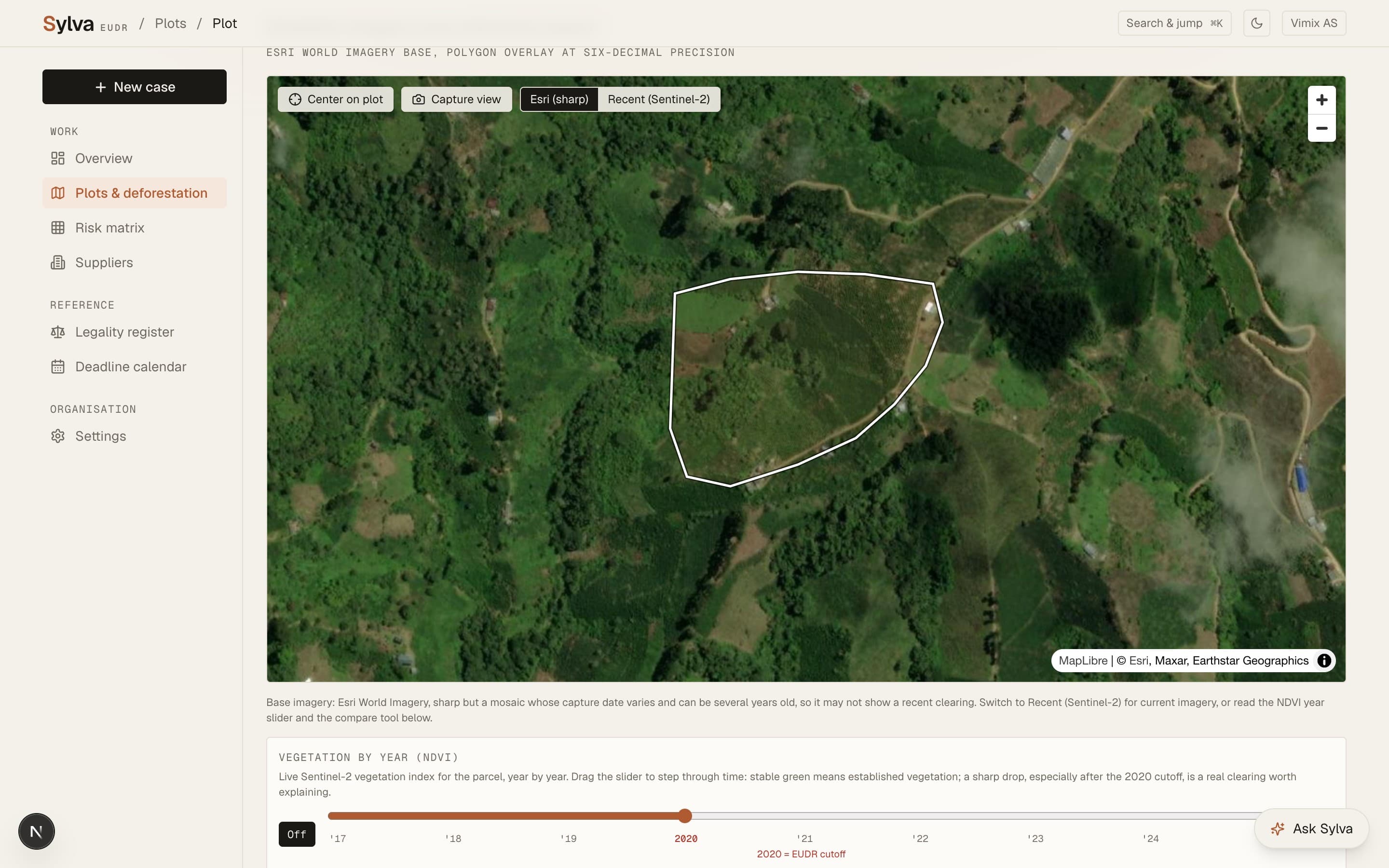
Every plot is screened live against the actual coordinates: WHISP (Open Foris, FAO) as the anchor, cross-checked against the EU’s own forest baseline and loss datasets, with quarterly Copernicus imagery reaching back past the 2020 cutoff so you can see the parcel as it stood on the date that matters. Behind each verdict sits a written decision trail an auditor can follow. Book a pilot to see it on your own coffee.
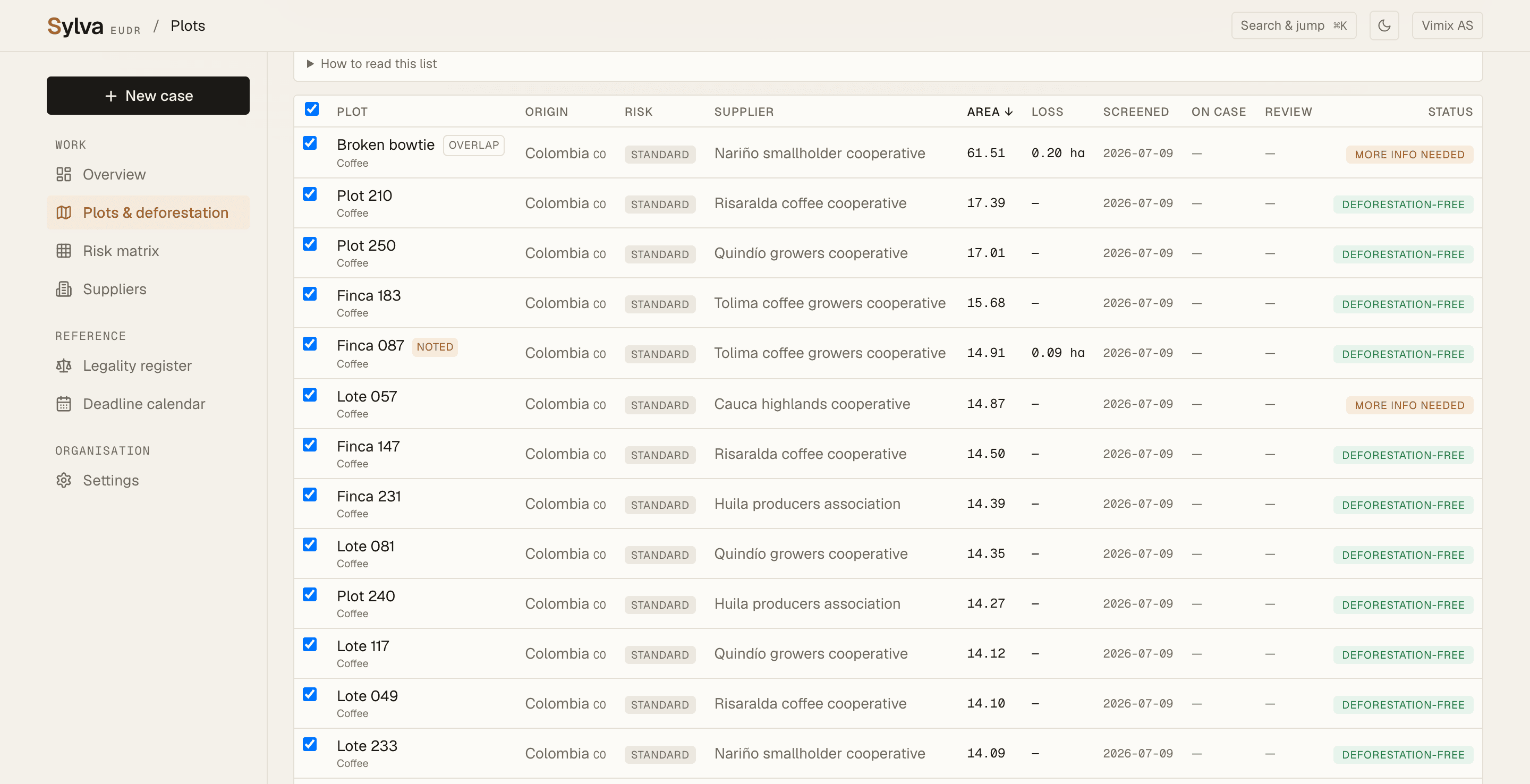
Every screened plot in one list, sorted so the parcels that need a look rise to the top. Select a set and re-screen it, run the overlap test, or attach it to a case in one go.
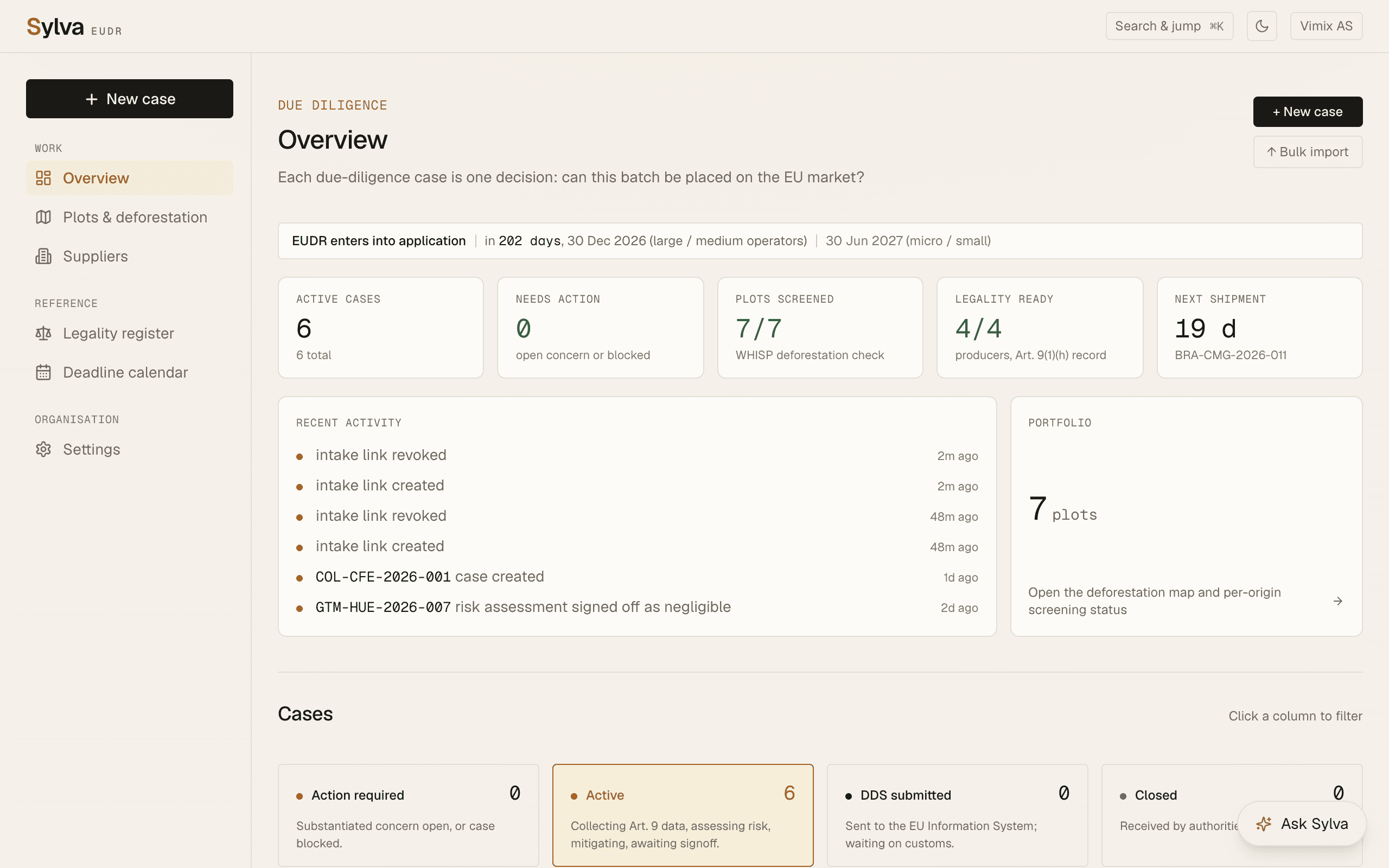
The overview. Each due-diligence case is one question: can this batch go on the EU market?
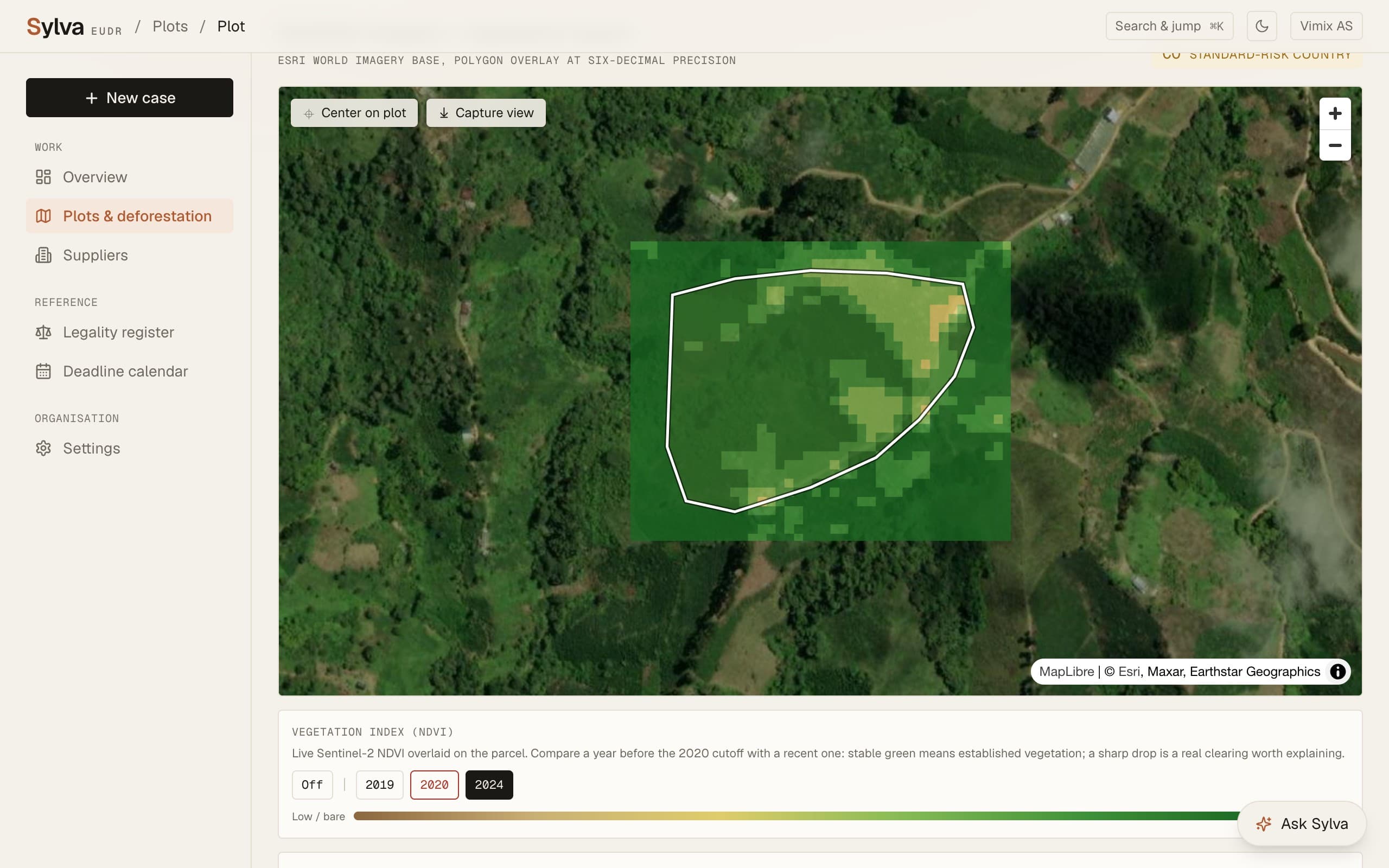
A flagged Colombia parcel with the live vegetation index drawn over it. Comparing 2019, 2020 and 2024 shows whether a loss signal is a real clearing or normal replanting.
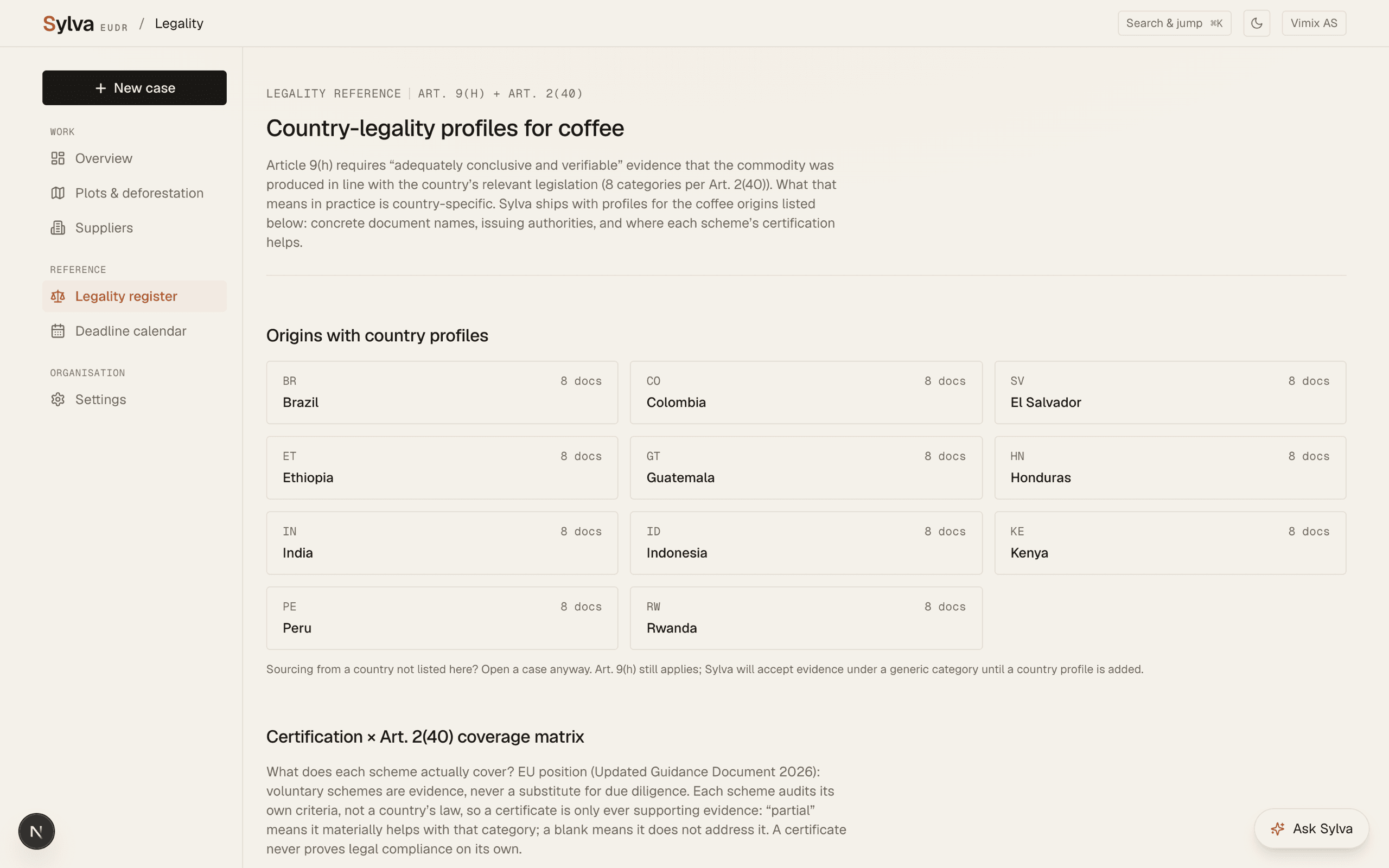
The legality register. For each origin, the legal instruments it expects under the eight Article 2(40) categories, so a confirmation is checked against what the country actually requires.
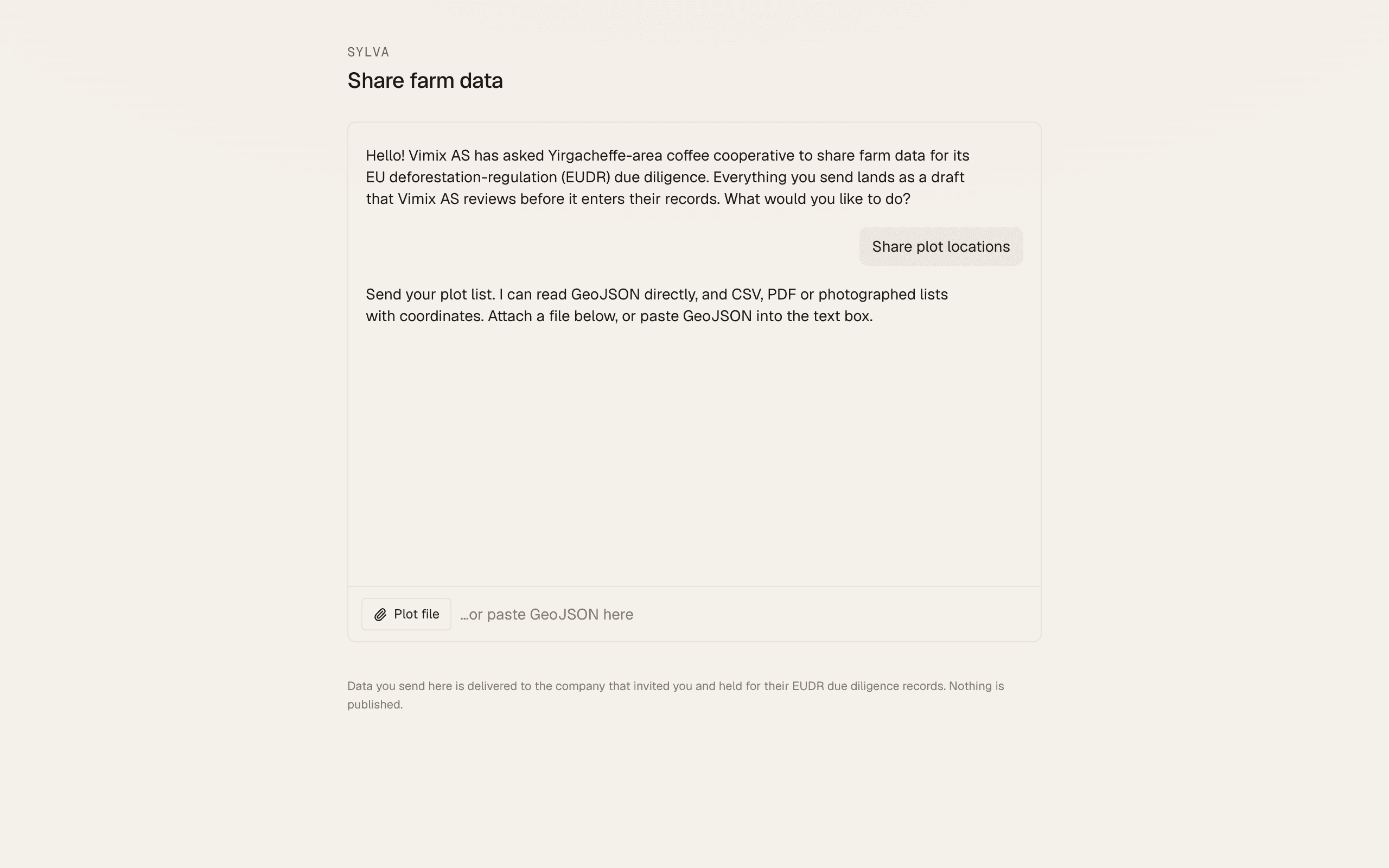
The supplier intake link. A cooperative delivers plots and documents from a phone, and nothing enters your records until you approve it.
Why coffee-first
Generic compliance tools miss what makes coffee hard.
Tree-cover loss is not deforestation
A loss of tree cover is not the same thing as deforestation. It might have happened before the 2020 cutoff, or be on land that was already a farm rather than forest, or simply be the pruning and replanting that are normal on a coffee plot. Sylva weighs WHISP’s verdict for the crop and sends an unclear signal to a person for review, instead of automatically failing the plot.
Cooperatives and smallholders
Origin supply runs through cooperative unions and thousands of member parcels. Sylva models the chain by actor and plot, and keeps the geometry and legality evidence per supplier.
The roaster-as-trader rule
Roasting keeps the same first four HS digits, so a roaster buying EU-placed green coffee is a trader, not a downstream operator (5th FAQ 3.1.1). Sylva sets the right role per case.
In the product
What goes into a case file.
Supplier intake links
Send a supplier a link that works on their phone, no account needed. They deliver plot lists and documents in a guided flow; everything lands as a draft you review and approve.
Geometry checks with nothing repaired in silence
Every boundary is checked against the Information System's own rejection rules. Lossless fixes are applied and logged; anything that changes the declared shape waits for your explicit acceptance, with the original kept on record.
Plot mapping and satellite view
Capture coordinates or polygons and see each plot on satellite imagery with the EU forest baseline.
Deforestation screening with a decision trail
Live per-plot screening against the 31 December 2020 cutoff: WHISP (FAO), the EU forest baseline and loss datasets, and quarterly satellite imagery, with the reasoning behind each verdict written down.
Legality per supplier
The initial legality examination and the eight Article 2(40) categories per producer, each either evidenced or recorded as not required under national law, with the justification written down.
Article 10 risk assessment
Work the risk factors to a documented negligible or not-negligible determination.
Article 11 mitigation
Open a mitigation case, with its supporting trail, when residual risk is not negligible.
Due-diligence statement
Assemble the DDS per batch, track quantity draw-downs against the declared volume, and pass the reference downstream.
Records an authority can check
One export bundles the case file, screening reports, geolocation and evidence for a competent-authority check, and the annual report drafts itself from your recorded data.
Where Sylva is today
Specialised in green coffee.
Sylva is young software, focused entirely on EUDR due diligence for green coffee. What it covers today is the whole working chain: plot intake from your suppliers, live screening on real coordinates with the EU and FAO satellite datasets, the legality record per producer, the risk assessment and the statement, and the records a competent authority would ask for. The one thing it cannot do yet is file to the EU Information System itself, because the renewed system is only now reopening; Sylva is built to its published API and submits the day it accepts filings.
It is built by Vimix AS, the independent climate and sustainability advisory of Martin Smedsrud Kristensen, who advises on the EUDR and has followed it since it was first proposed.
Built for the businesses that handle green coffee under the EUDR. That means importers and operators placing it on the EU market, and the downstream operators and traders who keep the records and pass on the due-diligence references. Other commodities are not covered yet.
Pricing is agreed with each pilot, and you do not need a long contract to try it.